Skateboard Design Ideas: 44 Themes and How to Lay Them Out
A skateboard design works when it fits the deck: a canvas about 1:3.7, seen mostly from underneath, with two bands — at 22–29 % and 73–79 % of the length from the nose — hidden by the trucks. Put the focal point in the clear stretch between them, let the rounded ends carry colour rather than detail, and pick themes that are tall, long or made of pattern.
Below are 44 themes, from wolves and galaxies to heartbreak, each with where it goes on the deck. The positions come from the template of the deck Skateboard Personalizado prints, one popsicle shape in 8.0", 8.25" and 8.5"; on any other deck, check where its holes are. Preparing the image and using the editor step by step is covered in how to design your own skateboard deck.
What makes a design work on a skateboard deck?
The shape, the trucks and the angle it is seen from. Get those three right and almost any theme fits; ignore them and a good drawing ends up with a truck across its face.
- A tall, narrow canvas. The deck is 20.3, 21.0 or 21.6 cm wide, depending on the size, and nearly four times longer than it is wide: a shape almost no image was framed for.
- Two ends that curve up. The nose and the tail, the kicks, bend upwards over roughly the last 18 % of the length at each end. Whatever sits there is seen at an angle, and it scuffs first when the board is ridden.
- Eight holes and two trucks. The trucks bolt through two groups of four holes, at 22–29 % and 73–79 % of the length from the nose. On a board that is ridden, the baseplate, the hanger and the wheels hide a band across the full width at each one. On a wall, the eight holes still show through the design.
- Seen from underneath. The graphic goes on the bottom face, which points at the ground while the board is ridden: people see it when the board flips or is carried, and all of it, holes included, when it hangs on a wall.
What is left is the clear band: the stretch between the inner rows of holes, from 29 to 73 % of the length. The middle third of the deck sits entirely inside it. That is where a face, a pair of eyes or the one word that matters belongs. The print template also keeps important things 6 % in from each side, about 1.3 cm, because the edges are the first thing a ridden deck wears.
| Zone | Share of the length, from the nose | Use it for |
|---|---|---|
| Nose kick | 0–18 % | Colour, pattern, the end of a gradient |
| Nose truck | 22–29 % | Nothing that has to be seen on a ridden deck |
| Clear band | 29–73 % | The focal point: faces, eyes, the main word |
| Tail truck | 73–79 % | Same as the nose truck |
| Tail kick | 82–100 % | Same as the nose kick |
How do you turn a theme into a deck layout?
Five decisions, in this order. They take a couple of minutes, and they are the difference between a picture stuck on a board and a deck design.
- Pick one subject. A wolf, not a wolf, a moon, a forest and a name. At 21.0 cm wide, one subject fills the deck; three fight over it.
- Decide how the deck will be seen. Ridden, the trucks hide two bands and the graphic faces the ground. Hung on a wall, everything shows, holes included. If it might be both, design for the ridden case.
- Put the focal point in the clear band. Between 29 and 73 % of the length. For a face, put the eyes just below the nose truck, around 35–40 % of the length from the nose.
- Give the kicks colour, not information. Background, pattern, the end of a gradient. No eyes and no small text.
- Check it in 3D with the trucks on. In the editor's 3D view, open the "…" menu and choose "Show the trucks". Turn the deck around and look at it from underneath with the trucks on, then switch them off and look again.
Where the source art comes from. Several themes below have a public-domain source: natural-history plates, Japanese prints, space photography, old anatomy books. In the EU, a faithful reproduction of a public-domain artwork gets no new copyright of its own (Article 14 of Directive (EU) 2019/790), which is what makes museum scans usable. Still, download from the institution itself, where the file is full size and the terms are stated. Licences, resolution and a longer list of archives are in where to get artwork for a custom deck. Characters, band logos and fan art are a separate question, because someone owns them; every theme on this page is generic on purpose.
Animal skateboard designs: wolf, cat, dinosaur, tiger and more
Animals work when their shape follows the deck's. Long bodies run along the length; faces sit in the clear band, with the eyes just below the nose truck.
- Wolf. A head-on portrait, eyes just below the nose truck and the ruff fading into the background towards the tail. Or a small wolf howling on a ridge two-thirds of the way down, under a full moon centred in the clear band. On a cold blue-grey palette, make the eyes the brightest point.
- Cat. A cat seen from behind, sitting, its tail curling down the length; or a face peeking up over the tail truck, eyes at the bottom of the clear band. The best cat deck is often a photo of your own cat.
- Dinosaur. A skeleton laid along the length like a museum fossil, skull in the clear band and tail running towards the tail of the deck. For a child's deck, a scattered repeat of small dinosaurs has no focal point for the trucks to cover.
- Tiger. Crop tight: the eyes across the width at the top of the clear band, stripes running edge to edge everywhere else. Orange and black is a high-contrast pair with no subtle tones to lose in print.
- Horse. Stack the frames of a galloping horse down the centre line: Eadweard Muybridge's 1878 photographs of horses in motion are out of copyright (he died in 1904), and the Library of Congress has them online. Or one rearing horse, a figure taller than it is wide, like the deck.
- Snake or rattlesnake. The one animal already shaped like a deck: an S-curve along the full length, head in the clear band, rattle towards the tail. Coiled around a dagger, it becomes a tattoo-flash design.
- Elephant. Head-on, ears spread across the width at the top of the clear band, trunk hanging down the length.
- Dog. A photo of your own dog beats any illustration (see photo decks). If you would rather draw one, a dachshund stretched along the length is a joke the shape tells for you.
- Duck. A row of ducklings walking up the deck from tail to nose, or a single bird from John James Audubon's The Birds of America, whose plates the National Audubon Society offers to download.
- Bunny. A hare mid-leap, stretched diagonally along the length. A soft pastel palette keeps its colour in print; give the outline enough contrast to read at a distance.
- Caterpillar. Segments spaced evenly up the centre line, head at the top of the clear band. Maria Sibylla Merian's 1705 plates of caterpillars and butterflies on their food plants are public domain, and the Biodiversity Heritage Library has them.
In print, fur and feathers are fine detail: they survive when they have contrast and turn to mush when the whole animal is mid-grey on mid-grey. For source art, natural-history plates are large, often portrait-format and long out of copyright.
Flower and nature designs: roses, mushrooms, butterflies, cherry blossom
Plants grow upwards, and so should the design: roots, stems or ground at the tail, and the bloom in the upper half of the clear band.
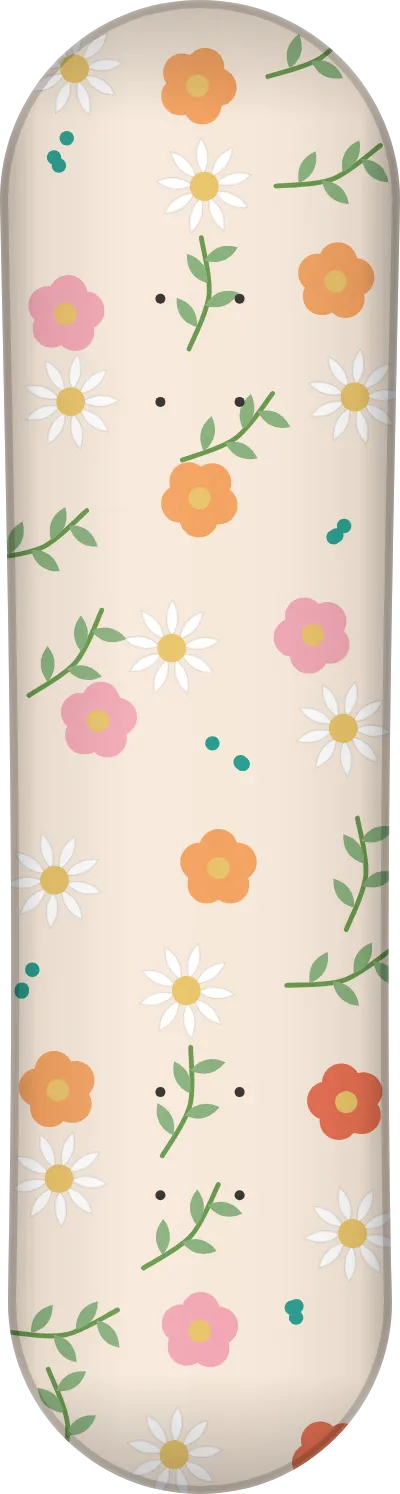
- Flowers. One botanical plate centred in the clear band, on a flat background colour picked from the plate itself. Or a scattered floral repeat edge to edge, like the Garden template, with nothing for the trucks to hide.
- Rose. A single stem rising from the tail truck, the bloom just below the nose truck. Pierre-Joseph Redouté's rose plates are public domain (he died in 1840), and the Biodiversity Heritage Library has editions of Les Roses.
- Mushroom. A cluster growing up from the tail, as if the tail were the forest floor; or one red toadstool with white spots, centred as an emblem. Red and white on a dark ground is about as legible as a colour pair gets.
- Butterfly. One symmetrical butterfly on the centre line, wings spanning the width: the editor snaps an element to the deck's centre line when you drag it close. Or a swarm rising from tail to nose, smaller towards the nose for depth. Merian's plates work here too.
- Cherry blossom. A branch entering diagonally from one edge, blossoms gathered in the clear band, petals drifting towards the tail. Pale pink reads better on navy or black than on white, where it disappears at a distance.
More nature starting points are among the templates: Jungle, Forest, Reef and Autumn (big leaves, misty pines, a reef with fish, falling maple leaves).
Galaxy and space designs
Space is the easiest theme to fit, because a starfield has no top, bottom or edge: run it edge to edge and turn it until the brightest part sits in the clear band.
- Galaxy or nebula. One full-bleed image, brightest region between the trucks. NASA says its own images are generally not subject to copyright in the United States; its logos are protected, and images credited to other organisations carry their own terms (NASA's media guidelines). Search the NASA Image and Video Library.
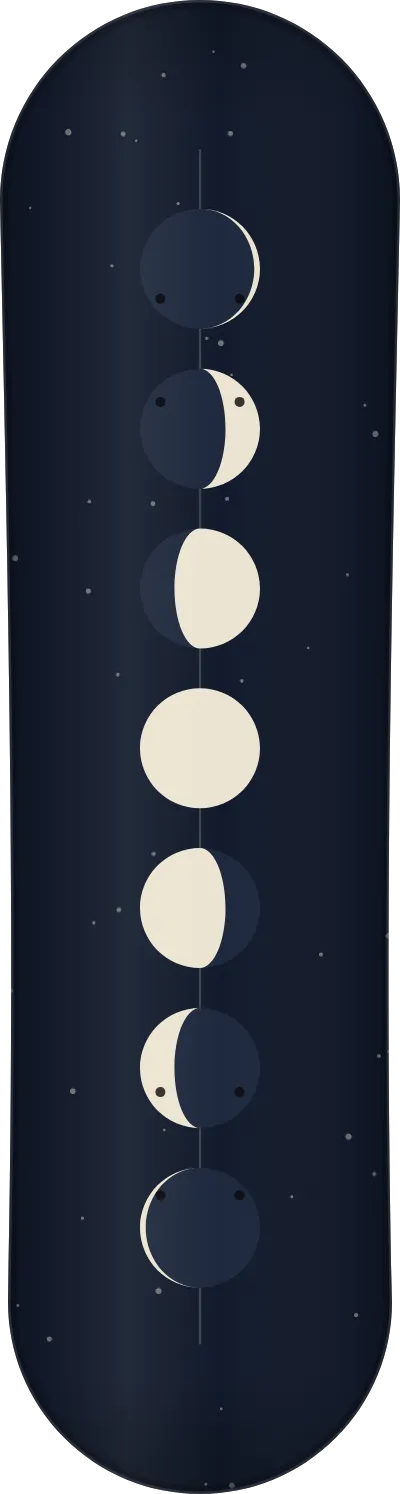
- Moon phases. Seven to nine phases stacked down the centre line, evenly spaced. The Moon template does exactly this; on a deck you will ride, pull them together so none sits under a truck.
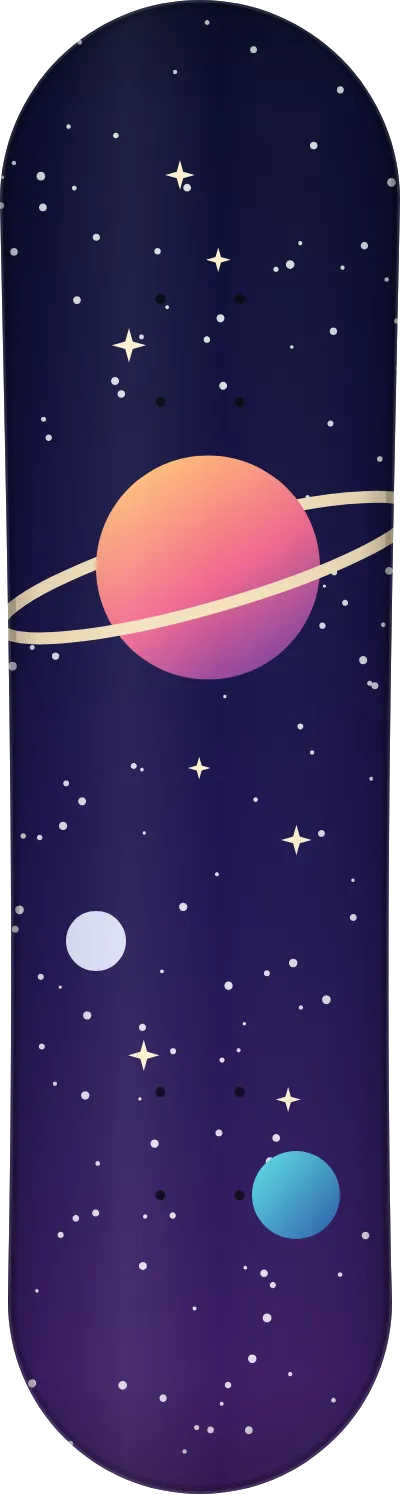
- Planets. One ringed planet as an emblem in the clear band, as in the Cosmos template, or a column of planets from nose to tail with the largest in the middle.
- Constellations. A star chart in white on navy, with the lines drawn thicker than feels necessary so they survive two metres of distance. Old star atlases are public domain, and the Constellations template is a ready-made start.
In print, deep space is mostly near-black, and detail that a bright screen shows in near-black is easy to lose in ink. Lift the shadows slightly before uploading, and keep the stars as the brightest thing on the deck. Eclipse and Northern lights are two more dark-sky templates.
Colour-led designs: pink, purple, rainbow, red and black
When the colour is the idea, keep everything else simple: one or two colours, one shape or one word. Then choose colours that survive the move from a backlit screen to ink. The most luminous screen colours — neon greens, electric purples, hot pinks, bright cyans — lose some punch in print; pastels, earth tones, black and strong warm colours travel better.
- Pink. The whole deck in one pink, set with the deck colour control, and a single word or shape in white or black. Pastel pink holds its colour in print; neon pink comes out a step duller than on screen.
- Purple. Pair it with its opposite, a yellow or orange accent, for contrast: the Mosaic template runs from purple into orange, and Peaks and Skyline sit under purple skies. Deep violets travel better than electric ones.
- Rainbow. Stripes running the full length, nose to tail, so every colour carries past the trucks; six equal bands on an 8.25" deck are 3.5 cm each. The Arches template does it as arches, and Curve as seventies stripes.
- Red and black. Two flat colours and nothing else: a checkerboard, a red rose on black, a black skull on red. It reads from across a room, and there are no subtle tones for print to lose.
- Holographic. Not as foil (see what a printed deck can't do). What can be printed is the look: a pastel gradient from peach through pink and lilac to periwinkle blue, with soft glows. It won't shift as the light moves. The Aura template is the nearest starting point.
- Glow in the dark. Not as ink either. The look is saturated cyan, magenta or green with soft halos on a near-black ground; the Neon style of the name generator draws it in cyan and pink. Printed, it doesn't glow.
Dark and gothic designs: skulls, reapers, zombies
Dark designs work on a deck when they are built on contrast, not on darkness. Black is the background; the subject needs light edges to be seen from two metres away.
- Skull. A symmetrical front-view skull on the centre line, eye sockets just below the nose truck. Add roses or a banner and it becomes a flash sheet. Anatomical woodcuts from the 1500s, such as those in Andreas Vesalius's Fabrica (1543), are public domain, and the US National Library of Medicine has the book online.
- Grim reaper. A hooded figure filling the clear band, the scythe blade crossing diagonally towards the nose: a figure taller than it is wide, like the deck. The Met's open-access collection includes 16th- and 17th-century Dance of Death prints.
- Goth or emo. A black deck, one accent colour (deep red, purple or hot pink) and one line of your own words. There is no blackletter typeface in the editor's font menus, so set gothic lettering in your own software and upload it as a PNG with a transparent background. Your own words, not a song lyric: lyrics belong to whoever wrote them.
- Zombie. Hands reaching up from the tail as if from the ground, the head breaking into the clear band; or a photo of you in Halloween make-up. Zombie greens and browns turn muddy next to each other, so set them against black with one bright accent.
Graphic styles: tattoo flash, graffiti, Japanese, pop art, lettering
A style is a set of rules, and following them is what makes a deck read as that style: heavy outlines for tattoo flash, tags and drips for graffiti, flat colour and pattern for Japanese prints, dots and bursts for pop art.
- Traditional tattoo. Bold black outlines, a handful of flat colours (red, yellow, green and black on cream) and one motif, such as a swallow, a dagger, a panther or a ship, with a banner across the clear band carrying a name. Draw it or commission it: copying an artist's flash sheet is copying their work.
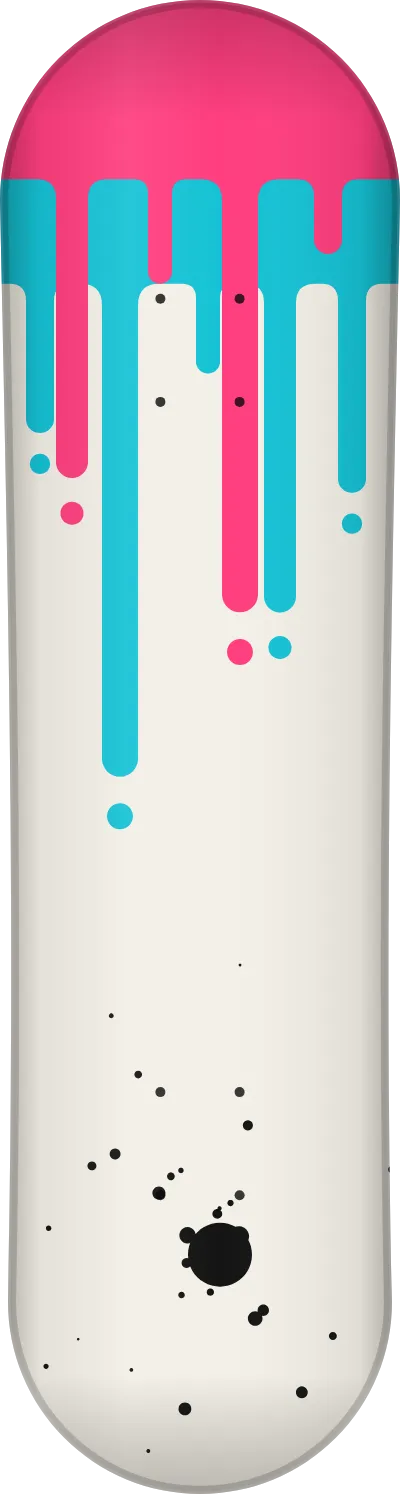
- Graffiti. Your own tag along the length, the text turned 90° with the rotation handle, in Permanent Marker, Rock Salt, Bangers or the stencil face Black Ops One, over the Bricks or Splash template. The Graffiti and Drip styles of the name generator do it for a name. A photo of someone else's wall is someone else's artwork.
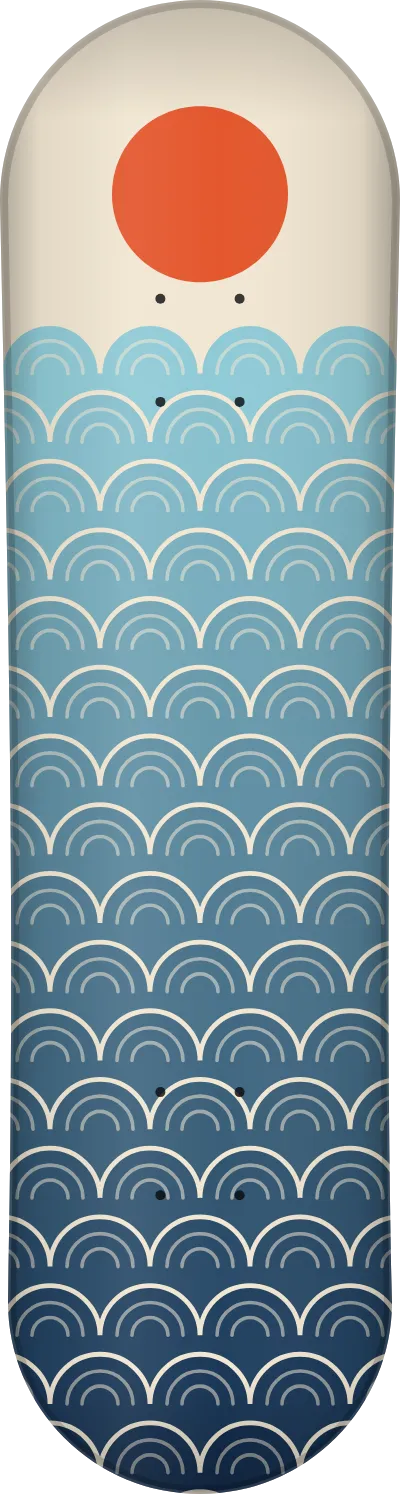
- Japanese woodblock. Pillar prints (hashira-e) are about 70 × 12 cm, a format even narrower than a deck: one fits almost the full length with a strip of colour down each side, and The Met publishes several as open access. The Tide template sets scale-like waves under a red sun. For kanji or kana, set them in your own software, have someone who reads Japanese check them, and upload them as an image: the editor's fonts don't include Japanese characters.
- Pop art. Halftone dots, a comic-book burst and one word in Bangers, all in flat primaries; the Pop art template has the dots and the bursts, and the word is yours to add. Flat colour with hard edges prints crisply.
- Lettering. One word, as big as the deck allows, running along the length. The name generator sets a name of up to 16 characters in 26 styles and opens the one you pick in the editor.
- Flames. Flames rising from the tail with the lettering in the clear space above them, which is what the Flames style of the name generator draws; or flames licking back from the nose like a hot-rod bonnet. Yellow into orange into red, on black.
Pattern designs: checkerboard, animal print, tie-dye
Patterns are the most forgiving designs for a deck: there is no focal point for the trucks to hide, and the kicks simply continue the repeat. The one decision is scale.
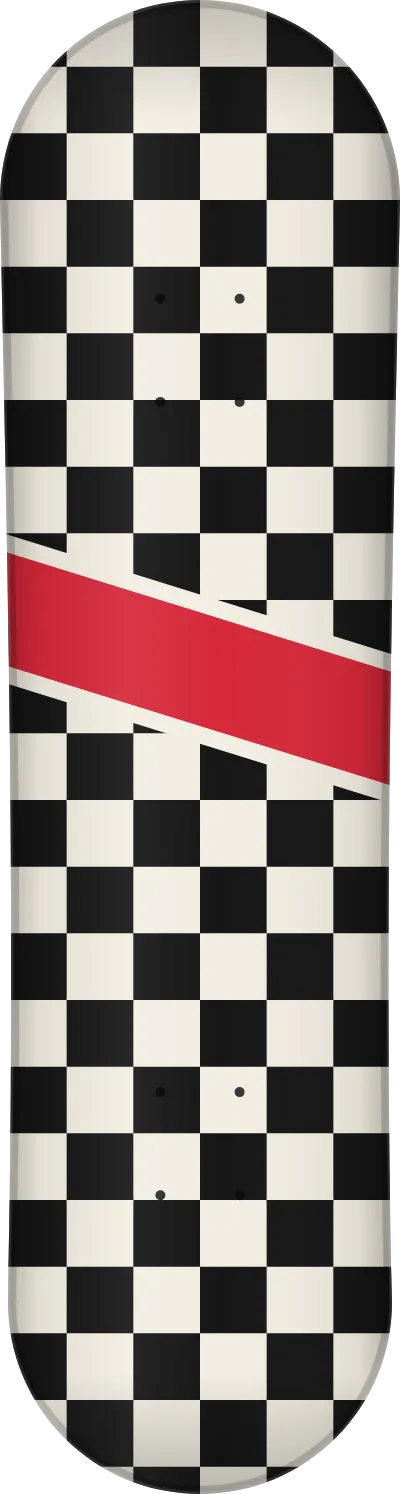
- Checkerboard. Choose the number of squares across first: six across an 8.25" deck makes 3.5 cm squares. An even number puts a seam on the centre line; an odd number centres a square. The Race template adds a diagonal band, Op art warps the checks, and the Checkers name style puts checks on both kicks and a name between them.
- Animal print. Leopard, cheetah, zebra or tiger stripe, scaled so that six to eight spots or stripes cross the width; any smaller and it turns into grey noise from across a room. A photo of real fur prints as a flat image, with no texture and no relief.
- Tie-dye. A spiral centred on the middle of the deck, which is also, almost exactly, the middle of the clear band. Tie-dye an old T-shirt, photograph it flat in daylight and upload it as the background: a texture nobody else has.
Photo decks
A photo becomes a deck design when it is tall: crop it to about 1:3.7, keep the subject in the clear band, and check the resolution before anything else.
- A portrait of a person or a pet. Eyes just below the nose truck, the rest of the body running down the length, background on the kicks. A face is the one thing you never want under a truck.
- A tall scene. A tree, a waterfall, a tower, a road running away to the horizon: subjects that are already vertical, rather than a wide landscape cropped to a sliver.
- A collage. Three photos stacked, each cropped to a portrait shape, rather than eight small ones where none can be read. The collage generator lays out three photos in four ways.
How much resolution a deck-sized print needs, and what a phone photo really gives, is worked out in where to get artwork for a custom deck. The short route is to upload it on your photo on a skateboard.
Designs about feelings: heartbreak and memory
Feelings have no standard picture, which is exactly why they make personal decks: one symbol, one date or one line of your own, placed in the clear band.
- Heartbreak or emotional pain. A cracked heart; a rose dropping its petals towards the tail; rain falling down the length. Or kintsugi, the Japanese practice of mending broken pottery with gold, drawn as a crack running through the design. It is printed, so the gold is a colour rather than a metal.
- In memory of someone. A name and two dates in the clear band, a photo above them, and nothing else. A quiet palette and large type say more than ornament.
Layout cheat sheet
Every theme above is one of a dozen layout types. Find yours in the first column.
| Design type | Best placement | Common mistake |
|---|---|---|
| Face or portrait (animal, person, skull) | Eyes just below the nose truck, 35–40 % of the length; the head inside the clear band | Eyes under a truck, or on the nose kick where they curve away |
| Single emblem (mandala, butterfly, sun, toadstool) | On the centre line, in the middle of the clear band | So big it runs under both trucks, or so small it reads as a sticker |
| Tall figure (reaper, rearing horse, rose on its stem) | Full height between the kicks, head or bloom in the upper clear band | The top cut off by the curve of the nose |
| Long body (snake, dachshund, caterpillar) | Along the length as an S-curve, head in the clear band | The body squeezed across the 21.0 cm width |
| Full-bleed image (galaxy, fur, marble, tie-dye) | Edge to edge, the brightest part turned into the clear band | A landscape image cropped to a sliver that no longer has the resolution |
| Repeating pattern (checkerboard, leopard, flowers) | Edge to edge, aligned to the centre line | A scale so small it turns grey at a distance |
| Stripes and rainbows | Along the length, bands of equal width | Stripes across the width, which the trucks break into pieces |
| One word or a name | Along the length, turned 90°, or short words stacked in the clear band | Small type that disappears beyond two metres |
| Sequence (moon phases, horse frames) | Down the centre line, evenly spaced between the trucks | Frames lost under the trucks on a deck that is ridden |
| Photo collage | Three or four portrait-shaped photos, stacked | Eight small photos, none of which can be read |
| One image across several decks (wall) | Equal slices, one per deck, each a design and an order of its own | Forgetting the gaps between the decks once they hang |
| Border or frame | Inset from the edge, following the outline | A rectangular frame, which the round nose and tail cut off |
Holographic, glow-in-the-dark, engraved: what a printed deck can't do
Some finishes are materials, not images, and print can only imitate them. Skateboard Personalizado prints every deck the same way, with UV inks on a transfer film applied to the underside of a 7-ply maple deck, so the result is always full colour and smooth, with no relief.
| Finish | On a printed deck? | What can be printed instead |
|---|---|---|
| Holographic or iridescent foil | No | A pastel gradient with soft highlights; it doesn't shift with the angle |
| Glow-in-the-dark ink | No | Luminous-looking colour on near-black; it doesn't glow |
| Metallic gold or silver foil | No | Gold drawn as yellow-to-brown gradients with pale highlights: it reads as gold from a distance and as colour up close |
| Engraving or burned lines | No | Dark-brown line art over a printed wood texture |
| Bare maple left unprinted | No: the whole underside is printed | A printed wood grain, like the Wood style of the name generator |
| Raised texture or embossing | No: the print is smooth | Texture as an image: a photo of fabric, paint or fur |
When the finish matters more than the image, a different technique is the answer: printing, hand-painting and vinyl are compared in printed, hand-painted or vinyl, and painting one yourself is covered step by step in how to paint a skateboard deck.
Easy skateboard designs that still look good
The easiest designs make the fewest decisions: one colour, one element, one place.
- One colour, one word. Set the deck colour and add a single word along the length.
- One big shape. A circle for a sun or a moon, or a single stripe: the Horizon and Eclipse templates are built that way.
- Two halves. The deck split lengthways into two colours, as in the Halves template.
- One photo, edge to edge. Nothing added. It works when the photo is already tall.
- A template, changed once. Swap the colour or add a name.
For something less expected: a map of a place that matters (the City map, Metro and Topography templates), a scan of a child's drawing or a handwritten note at 300 dpi or more, or one image split across two or three decks, which is covered in skateboard wall art ideas. If the deck is a present, custom skateboard gift ideas goes through who it is for.
Where to start in the editor
From a template, a name, a photo, or a blank deck in your own software. The templates page shows all 55 templates in 5 groups (minimalist, artistic, sports, nature and urban), and each one opens in the editor already applied, ready to change.
| If your theme is… | Start from |
|---|---|
| Space | Cosmos · Constellations · Moon · Eclipse · Northern lights |
| Flowers and nature | Garden · Jungle · Forest · Reef · Autumn |
| Colour | Aura · Arches · Curve · Mosaic |
| Street and graffiti | Splash · Bricks · Stickers |
| Pop and psychedelic | Pop art · Psychedelic · Op art · Memphis |
| Patterns | Race · Stained glass · Mandala |
| Japanese | Tide |
| Places and maps | City map · Metro · Topography · Skyline |
- A name. The name generator sets up to 16 characters in 26 styles, Graffiti, Flames, Rainbow, Checkers, Neon and Wood among them, and opens the one you pick in the editor.
- A photo. Your photo on a skateboard starts from one upload, and the collage generator from three.
- Someone else's design. The public gallery holds designs people chose to publish, with a search box, and any of them can be used as a base.
- Your own software. The print template gives the exact outline for each width as a vector file; how to work with it is in the skateboard deck template guide.
Designing is free, and you don't need an account to try it or to order; you pay only if you order the deck.
Frequently asked questions
Where can I find unique skateboard designs for a theme like wolves, galaxies or mushrooms?
Three kinds of places: skate brands' own graphics, independent artists' shops, and custom printing services where you upload your own design, which is the route to a deck nobody else has. Skateboard Personalizado prints a design you compose in the browser, from your own art, a public-domain print or one of its templates, on a 7-ply maple deck for 89 €, with shipping in Spain included and from 15 € more per order to the rest of the EU, depending on the country.
What are some cool skateboard design ideas?
Ideas that use the deck's long, narrow shape: a snake or a dachshund stretched along the length, moon phases stacked down the centre, a Japanese pillar print, flames rising from the tail, a checkerboard, or a map of a place that matters to you. Keep the focal point between the trucks, from 29 to 73 % of the length, where nothing covers it.
What are easy skateboard designs to make?
One colour and one word along the length; one big shape, such as a circle for a sun; the deck split lengthways into two colours; one tall photo edge to edge; or a ready-made template with one change. None of them needs any drawing.
Can I customise a skateboard with a cat or caterpillar design?
Yes. A cat works as a portrait with the eyes just below the truck nearest the nose, as a cat seen from behind with its tail curling down the length, or as a photo of your own cat. A caterpillar suits the deck's shape: segments spaced evenly up the centre line, head near the top of the clear stretch between the trucks. Maria Sibylla Merian's 1705 plates of caterpillars and butterflies are public domain. Skateboard Personalizado ships to Spain and most of the EU, not to the UK.
Can I get a holographic or glow-in-the-dark skateboard deck?
Not from Skateboard Personalizado as a real effect: every deck is printed with UV inks on a transfer film, so there is no holographic foil, no glow-in-the-dark ink, no engraving and no bare wood left showing. What can be printed is the look, a pastel iridescent gradient or luminous-looking colour on near-black, but it stays a flat print: it doesn't shift with the light and it doesn't glow.
Where should the main image go on a skateboard deck?
Between the two trucks, from 29 to 73 % of the length from the nose. The trucks bolt on at 22–29 % and 73–79 % and hide those bands when the board is ridden, and the nose and tail curve up over roughly the last 18 % at each end. For a face, put the eyes just below the truck nearest the nose.
What skateboard designs symbolise emotional pain or heartbreak?
A cracked heart, a rose dropping its petals, rain falling down the length of the deck, or kintsugi, the Japanese practice of mending broken pottery with gold, drawn as a crack running through the design. A date or one line of your own words works too; song lyrics belong to whoever wrote them. Keep the symbol in the clear stretch between the trucks, where nothing covers it.
Lay out yours
Start from a template or a blank deck, check it in 3D with the trucks on, and order only if you like it. A deck is 89 € with shipping in Spain included, or from 15 € more per order to the rest of the EU, depending on the country. Griptape and parts are separate.
Open the editor