How to make a skateboard triptych for your wall
A skateboard triptych is one image split across three decks that hang side by side, with a narrow gap between them, so they read as a single piece of art. In our editor you choose how many decks the set has, from 2 to 10, upload the image, and it spreads across all of them with the gap they will have on the wall. Each deck costs 89 €, the same as a single one, and the whole set goes in one order. Below: which image works, how to set it up step by step, how to hang the decks so the picture lines up, and what it costs.
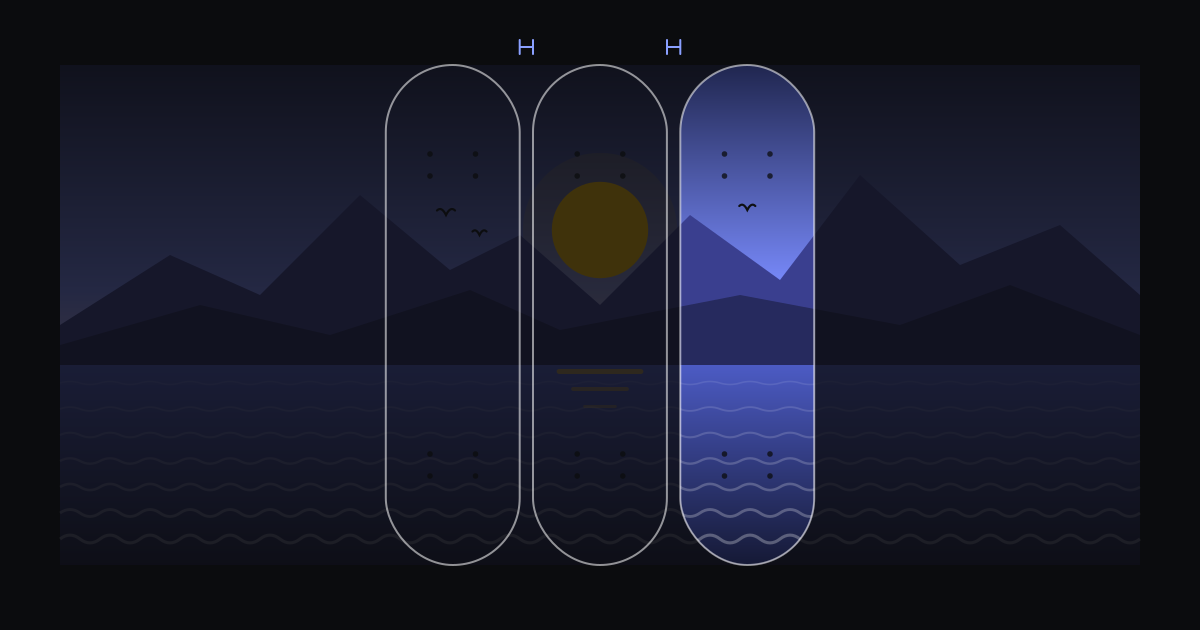
What a skateboard triptych is, and why it works
The word comes from painting: a triptych is a work in three panels meant to be seen together, like Hieronymus Bosch's Garden of Earthly Delights in the Prado in Madrid. With skateboard decks the idea is the same, with one practical difference: the three decks are identical, and the image runs from one to the next across the gaps.
- It changes the shape. One deck on its own is long and narrow; three together make an almost square block, the size of a large painting. Above a sofa, a headboard or a shop counter, they fill the wall in a way a single deck can't.
- The gaps add rhythm. You still read the whole picture, but cut into vertical strips, which turns it into something more than a blown-up photo.
- They are still decks. Real 7-ply maple skateboard decks: if you ever take them down, each one can be set up and skated like any other.
How many decks: from 2 to 10
A triptych is three, but the editor lets you go from 2 to 10. What changes with the number is the shape of the set, and the shape decides which image fits without losing too much. All the decks in a set are the same size; the set is as tall as one deck is long, and each extra deck makes it wider:
| Decks | Width : height of the set | Closest photo format | Price |
|---|---|---|---|
| 2 | 0.6 : 1 | 9:16 | 178 € |
| 3 | 0.9 : 1 | 4:5 | 267 € |
| 4 | 1.2 : 1 | 5:4 | 356 € |
| 5 | 1.4 : 1 | 3:2 | 445 € |
| 10 | 2.9 : 1 | 3:1 | 890 € |
Proportions worked out from the deck outline and the gap the editor uses. The format is the closest common one (width:height); a photo with a different shape still works, it just loses more at the sides or at the top and bottom.
- Two decks (9:16, taller than wide): the shape of a vertical phone video. Good for a couple, one deck each; the idea is covered in the Valentine's deck guide.
- Three decks (4:5, nearly square): the classic triptych. A portrait, a square photo or an illustration drawn for that shape fits well.
- Four or five (5:4 and 3:2): now wider than tall, and a landscape phone photo (4:3) falls between the two. Landscapes and group photos.
- Six to 10 (up to 3:1): a true panorama. A horizon, a skyline, the wall of a shop or bar.
Which image works
In a set, the photo comes in covering every deck and centred; then you move and scale it as you like. Four things decide whether it works:
- Keep the subject out of the gaps. The image carries on behind each gap, and the strip that falls there is not printed. A horizon or a sky takes that without anyone noticing; a face, a pair of eyes or a word cut down the middle does not. Put what matters in the middle of a deck (in a triptych, the centre one), or make it big enough to span several decks so the gap lands on an area without detail.
- Big shapes beat thin lines. When you hang them, one deck can sit slightly off from the next, and a thin line crossing the gap gives that away. A mountain, a wave or a block of colour doesn't.
- Holes and tips. Every deck has its eight truck holes, in two groups of four, going through the image. And the tips are rounded, so the corners of the rectangle are not printed either. Keep small details away from those areas.
- Resolution, multiplied. An image spread over three decks is printed across the width of all three, so it needs the pixels for all three.
How many pixels you need
Below 150 pixels per inch at full size, a print looks soft. To cover a set of 8.25" decks at that minimum, the image needs at least:
| Decks | Width | Height |
|---|---|---|
| 2 | 2600 px | 4620 px |
| 3 | 3960 px | 4620 px |
| 4 | 5320 px | 4620 px |
| 5 | 6680 px | 4620 px |
A 12-megapixel phone photo (4032 × 3024 px) falls short: upright on a triptych it gets to about 115 ppi, and sideways even less. For a set, look for a camera photo, your phone's full-resolution mode if it has one, a large scan of an illustration, or an artwork downloaded at full size from a museum archive. Why resolution matters so much is explained in what photo works on a skateboard deck, and where to find large images you're allowed to print in where to get artwork for a custom deck.
How to make it in the editor, step by step
- Open the editor with three decks. This link opens it as a triptych; if you had a design in progress, it opens that one, spread over three. From the regular editor, open the “…” menu at the bottom left and, under “Decks”, press + until you reach the number you want: a small drawing of the decks appears next to it.
- Pick the size in the same menu. Every deck in the set will be that size; the size guide explains the difference. For the wall, the size mostly decides the overall width.
- Upload the image with the image button in the toolbar (“Upload image”; on a phone, “Add” and then “Photo”). It comes in covering the whole set, centred. While it is selected you also see the part that falls outside the decks: move and enlarge it until what matters is well away from the gaps.
- Decide the number before you frame it. If you change it afterwards, a photo that covered the set keeps covering it (enlarged if needed), and everything else stays where it was. You can undo it, but you'll have to frame the picture again.
- If you add text, keep it inside one deck. The editor's centring guides are those of the whole set: centred text lands on the middle deck of a triptych, but in a set of two or four it would fall right in a gap. Templates, which are made for one deck, are also placed in the centre.
- Check it in 3D and order. You see the decks together, side by side, before you pay. The “Order” button already shows the price of the whole set, and the order lists it as a “Set of 3 decks”.
How to hang it with the same gap as the editor
The editor leaves the deck's width divided by 10 between one deck and the next: about 0.8 in (2.1 cm) on an 8.25" deck. The image is built around that gap, because the strip lost at each one is exactly that wide. Hang them with the same spacing and a horizon stays straight and a diagonal carries on along the same line from deck to deck. With a different gap, wider or narrower, horizontal lines still match, but diagonals and curves stop lining up. So for a triptych, forget the generous spacing that suits separate decks.
- Measure your deck at its widest point and divide by 10: that's your gap. Cut two spacers of that width from card or a thin batten; they become your gauge between decks.
- Make a paper template. Lay one deck on brown paper, trace the outline and mark the eight holes. Tape it to the wall, level it, mark the holes, then slide it across by the deck's width plus the gap to mark the next one. Because the holes sit in the same place on every deck, the distance from one hole to the same hole on the next deck is always that.
- Level one line only. With a spirit level or a laser level, draw one horizontal line for the top holes of every deck. A small height difference between two decks breaks a horizon more than any gap does.
- Fix them all the same way. Two screws per deck, through the truck holes, with a spacer on each, because the deck doesn't sit flat against the wall: the nose and tail touch first. Use the same spacer on every deck so they all stand off the wall by the same amount. On plasterboard, a horizontal batten screwed to the wall with the decks fixed to it solves the fixing and lines them up at the same time. The details, and the no-drill options, are in how to hang a skateboard on the wall.
- In order, nose up. Every deck in the set is designed nose up, and the image itself tells you which goes left, centre and right. Hang the centre one first and work outwards with the gauges.
As for height, put the centre of the set at eye level or, above a sofa or a bed, leave some air over the back or the headboard. A wall mount isn't included, and we don't sell one at the moment.
Skateboard triptych ideas
- A landscape with a horizon. Sea, mountains, a sunset: the horizon runs across every deck and is exactly what handles the gaps best. Put the sun, the moon or the peak in the middle of one deck.
- A portrait. Three decks make an almost square block, so a portrait you would have to crop hard for one deck fits nearly whole here. The face goes entirely inside the middle deck; the side decks carry hair, shoulders or background. It works for a pet portrait too.
- Your city's skyline. A photo or an illustration of the skyline, ideally on five decks or more, since it is a panoramic shape. Make sure the tower or spire everyone recognises doesn't land in a gap.
- Public domain art. Japanese prints such as Hokusai's wave, landscapes by old masters, antique maps or botanical plates: many museums publish them in high resolution and free of rights, and this guide lists where, and what to check first. Leave out characters, logos and brands: they belong to someone, however easy they are to find.
- A group photo. The team, the crew, the family or the friends from a trip, across four or five decks, arranged so the gaps fall between people and never on a face.
- A commissioned illustration. If you draw, or you're commissioning someone, start from the shape of the set (the proportions table above) and let the gaps fall on areas without detail.
Other ways to group several decks on a wall are in skateboard wall art ideas, and if the triptych is going into a skater's room, there are more ideas for that space in skateboard bedroom ideas.
What a skateboard triptych costs
Each deck in the set costs 89 €, the same as a single one: there's no set discount and no surcharge. A triptych comes to 267 €; the proportions table above gives the price for each set size, up to 890 € for 10 decks.
- One order, one delivery charge. The set is one design, so it goes in one order with one shipping charge: free in Spain and from 15 € per order to the rest of the EU, depending on the country. We don't give delivery times outside Spain.
- Several identical sets. The order quantity counts sets, not decks: two identical triptychs are six decks. Up to 6 triptychs fit in one order, because the limit is 19 decks.
- Extras are per deck. If you add something (griptape, trucks, wheels…), it goes on every deck in the set and is charged for each one. You need none of that to hang them: the deck arrives on its own.
- No mount. Screws, wall plugs and spacers are up to you.
What's in the price of a single deck, and what costs extra, is in what a custom skateboard deck costs.
Frequently asked questions
What is a skateboard triptych?
One image split across three decks that hang side by side with a narrow gap, so they read as one piece. In our editor a set can have from 2 to 10 decks, and the image spreads across them with the gap they will have on the wall.
How much does a skateboard triptych cost?
Each deck costs 89 €, the same as a single one, so a triptych is 267 €. It is one order with one shipping charge: free in Spain and from 15 € to the rest of the EU, depending on the country. A wall mount is not included.
How far apart should the decks hang?
The same gap you see in the editor: the deck's width divided by 10, about 0.8 in (2.1 cm) on an 8.25" deck. The image loses exactly that strip at each gap, so with that spacing lines stay straight from one deck to the next.
What kind of photo works on a triptych?
One with big shapes and the subject away from the gaps: a landscape with a horizon, a skyline, or a portrait with the whole face on the middle deck. It needs more resolution than a single deck: a 12-megapixel phone photo falls short.
Can you skate the decks from a triptych?
Yes. They are real 7-ply maple skateboard decks, and each one can be set up with trucks, wheels and griptape like any other. If you add those extras to the order, they go on every deck in the set and are charged per deck.